


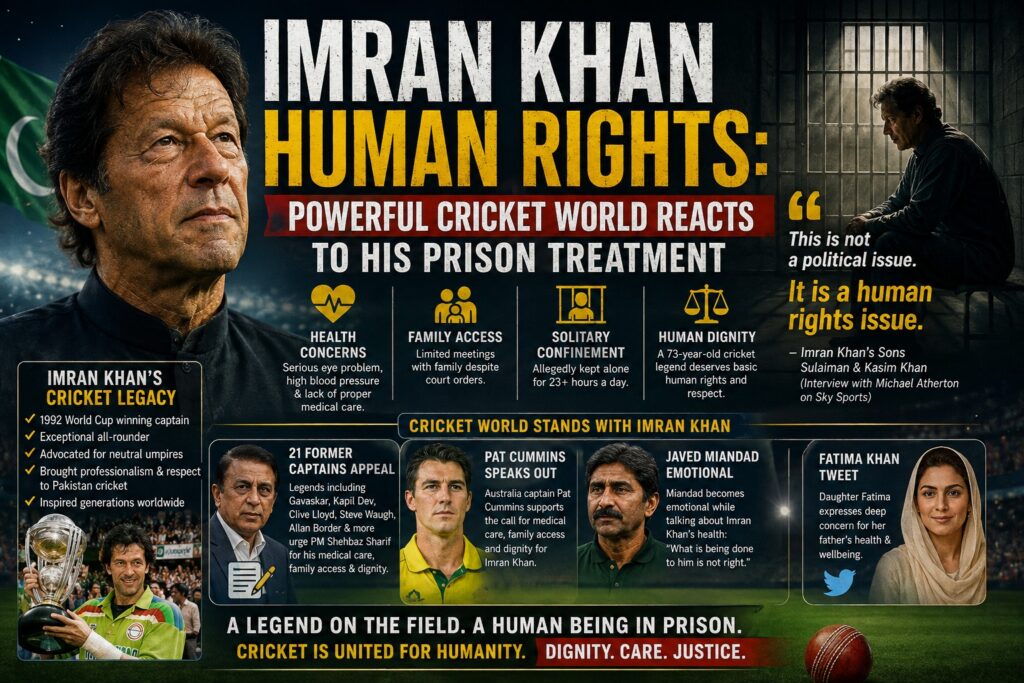
Imran Khan human rights concerns have moved beyond Pakistan’s political debate and into the international cricket community after a powerful interview with his sons, Sulaiman and Kasim Khan, conducted by former England captain and Sky Sports broadcaster Michael Atherton.
The interview, recorded at Lord’s and broadcast by Sky Sports during the England-Pakistan Test, focused largely on the health, prison conditions and family access of Pakistan’s former captain and 1992 World Cup-winning leader.
The controversy became even bigger when the Pakistan Cricket Board reportedly complained to Sky Sports and considered preventing its players from returning to the field if the interview was broadcast.
But there is another way to look at this story.
This does not have to be a political argument.
It can simply be a human story about a 73-year-old former cricket captain, a sporting icon, a father and one of the most influential figures in Pakistan’s cricket history.
Table of Contents
- What happened at Lord’s?
- What did Imran Khan’s sons tell Michael Atherton?
- Why the PCB objected to the interview
- The health concerns surrounding Imran Khan
- 21 former cricket captains appeal to Shehbaz Sharif
- Pat Cummins joins the cricketing world’s appeal
- Javed Miandad becomes emotional
- Imran Khan’s enormous contribution to cricket
- Why this should be viewed as a human-rights issue
- What happens next?
What Happened at Lord’s?
The controversy erupted during the second Test between England and Pakistan at Lord’s.
Former England captain Michael Atherton interviewed Imran Khan’s sons, Sulaiman and Kasim, about their father’s current situation in prison.
The interview lasted around 18 minutes and was broadcast by Sky Sports during the lunch interval.
According to multiple reports, the Pakistan Cricket Board lodged a formal complaint with Sky Sports and reportedly threatened that Pakistan’s players might not return to the field for the afternoon session if the interview was aired.
The interview was eventually broadcast, and Pakistan did return to the field.
Read the Sky Sports report on the wider humanitarian appeal
Fox Sports Australia also reported on the dispute, but it is important to distinguish the roles of the broadcasters: Sky Sports aired the interview, while Fox Sports reported on the controversy as part of its coverage of the Test series.
What Did Imran Khan’s Sons Tell Michael Atherton? 

The most emotional part of the interview was the description of their father’s reported condition.
Sulaiman and Kasim said they had become increasingly worried about Imran’s physical and mental wellbeing.
One of their biggest concerns was his eyesight.
Sulaiman said his father had lost approximately 80 percent of the vision in one eye and claimed that Imran had complained about the problem for months without receiving what the family considered adequate treatment.
The brothers also described concerns about blood pressure and the psychological impact of prolonged isolation.
Kasim said Imran was reportedly being kept alone for more than 23 hours a day.
The brothers described the situation as dramatically worse than before and said their father appeared visibly stressed when family members were finally able to see him.
They also questioned why an independent doctor had not been allowed to conduct a full assessment.
According to their account, Imran was examined by government-selected doctors for approximately an hour before being returned to prison.
They argued that an independent medical assessment would provide greater confidence for both the family and the public.
Another deeply personal issue was family contact.
The brothers said they had not seen their father since November 2022 and had been unable to obtain visas to visit him in Pakistan.
They said their last conversation with him was in March 2026 and that communication had subsequently become extremely limited.
They also said other family members had faced difficulties visiting him despite court directions concerning family meetings.
The brothers made extremely serious allegations about the authorities’ intentions. Those allegations are their claims, not established facts, and should be treated accordingly.
Their broader message, however, was straightforward: they want their father to receive proper medical care and to be allowed meaningful contact with his family.
Why Did the PCB Object?
The PCB’s reported objection centred on the inclusion of what it regarded as political material during Test-match coverage.
From the board’s perspective, international cricket broadcasts are primarily intended to cover cricket.
That position is understandable as a matter of sports broadcasting.
However, the counterargument is equally important.
Imran Khan is not simply a former politician appearing in a political interview.
He is also the only Pakistan captain to have led the country to a men’s Cricket World Cup title, a former international all-rounder and a figure whose cricketing career has influenced generations of players.
Michael Atherton himself described the discussion as a humanitarian appeal concerning the health and wellbeing of a former cricketing great.
That distinction matters.
The Health Concerns Surrounding Imran Khan
The health debate intensified after Pakistan’s Supreme Court reportedly directed that Imran Khan be moved for medical assessment, with the medical process involving doctors connected to him and his sister, Dr Uzma Khan.
The international cricket community became concerned after reports that Khan was instead examined by a government medical team and subsequently returned to Adiala Jail.
The former captains who have spoken out are not asking to decide Pakistan’s political or legal disputes.
Their central request is much narrower:
Let the medical process happen independently, allow family visits, and provide whatever treatment qualified doctors recommend.
That is why the issue can reasonably be discussed through the lens of human dignity rather than party politics.
The Pakistani government has rejected allegations of mistreatment and medical neglect. Officials have said Khan has access to food, books, television, exercise facilities and visitors, and have disputed claims that he has been denied appropriate care.
That response should also be part of any responsible report.
21 Former Cricket Captains Appeal to Shehbaz Sharif 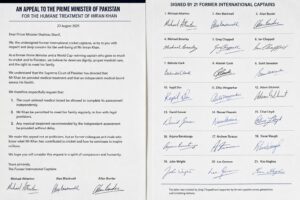

Perhaps the strongest evidence that this is not simply a political campaign comes from the international cricket community itself.
On August 23, 2026, a group of former international captains renewed their appeal to Pakistan Prime Minister Shehbaz Sharif regarding Imran Khan’s medical treatment and welfare.
The letter followed an earlier appeal by 14 former captains in February.
The renewed letter was initiated by former Australia captain Greg Chappell.
Among the signatories were major names from cricket history, including: 
- Michael Atherton
- Alex Blackwell
- Allan Border
- Michael Brearley
- Greg Chappell
- Ian Chappell
- Belinda Clark
- Alastair Cook
- Sunil Gavaskar
- Kapil Dev
- Dilip Vengsarkar
- Adam Gilchrist
- David Gower
- Nasser Hussain
- Clive Lloyd
- Arjuna Ranatunga
- Andrew Strauss
- Steve Waugh
- John Wright
- Lee Germon
- Kim Hughes
The letter made three central requests:
First, allow the court-directed medical board to complete an independent assessment.
Second, ensure weekly family visits continue without unnecessary interruption.
Third, provide without delay any treatment recommended by the independent assessment.
Most importantly, the former captains explicitly presented themselves as former colleagues and rivals from the cricket field rather than political actors.
Read the published copy and details of the 21-captain letter to Prime Minister Shehbaz Sharif
Pat Cummins Adds His Voice 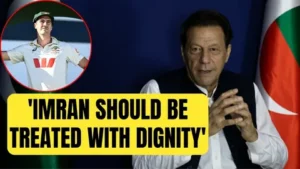
The issue then received support from one of the biggest names in modern cricket.
Australia’s current captain, Pat Cummins, publicly supported Greg Chappell and the former international captains.
Cummins wrote that he hoped the court-ordered medical assessment would be allowed to run its course, that family visits would continue, and that Imran Khan would be treated with the dignity anyone deserves.
That statement is significant because Cummins is not a former politician, activist or Pakistani political figure.
He is the captain of Australia.
His message was about medical care, family access and dignity.
Those are principles that should matter in sport regardless of nationality.
Javed Miandad’s Emotional Response 
There has also been an emotional response from within Pakistan’s cricket family.
Javed Miandad, Imran Khan’s former teammate and one of Pakistan’s greatest batsmen, recently spoke about Imran’s situation in a podcast appearance.
Miandad became visibly emotional while discussing his former captain and teammate and questioned what was happening to him.
He described the situation as unnecessary and said he hoped there would be a quick resolution.
For cricket fans, the emotion is understandable.
Miandad and Imran were part of one of the greatest periods in Pakistan cricket.
They shared dressing rooms, international battles and ultimately helped create the foundation for the Pakistan side that won the 1992 World Cup.
Watch the Javed Miandad podcast appearance and his reflections on Imran Khan
Imran Khan’s Contribution to Cricket 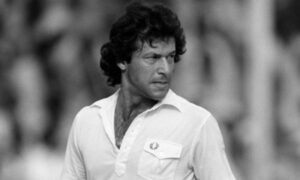

To understand why the international cricket community continues to speak about Imran Khan, it is necessary to remember what he gave to the sport.
Imran was an exceptional all-rounder.
He finished his Test career with 3,807 runs and 362 wickets, numbers that place him among the greatest all-rounders in cricket history.
But statistics only tell part of his story.
His greatest cricketing achievement came in 1992.
Pakistan entered the World Cup with an experienced but ageing side and suffered difficult moments during the tournament.
Yet Imran’s leadership transformed the team.
Pakistan defeated England in the final at Melbourne Cricket Ground and lifted the World Cup for the first time.
The image of Imran holding the trophy remains one of the defining pictures in Pakistan’s sporting history.
His influence also extended beyond winning matches.
One of the most important contributions associated with his captaincy was the push for neutral umpiring.
During the 1980s, controversy surrounding home umpires was a recurring issue in international cricket.
Imran advocated the use of neutral officials and invited Indian umpires, including Piloo Reporter and V.K. Ramaswamy, to officiate in Pakistan.
That experiment became part of a broader evolution toward independent and neutral umpiring in international cricket.
Today, independent officiating is considered a normal and essential part of international cricket.
That is part of Imran Khan’s cricketing legacy.
Why This Should Be a Human-Rights Conversation
This is perhaps the most important point.
You do not have to support Imran Khan’s political party.
You do not have to agree with his political decisions.
You do not even have to agree with his views.
You can still believe that a prisoner deserves proper medical attention.
You can still believe that a 73-year-old man should have access to qualified doctors.
You can still believe that court-ordered family visits should be respected.
And you can still believe that a former World Cup-winning captain deserves dignity.
That is the distinction this story needs.
This is not about asking cricket fans to take a political side.
It is about asking whether sporting institutions, governments and societies can protect basic human dignity even when they disagree with an individual’s politics.
The international cricket community appears to be making precisely that argument.
Greg Chappell has spoken.
Michael Atherton has spoken.
Sunil Gavaskar and Kapil Dev have signed.
Steve Waugh, Allan Border, Ian Chappell, Alastair Cook, Nasser Hussain and many other former captains have signed.
And now Pat Cummins has added his voice.
That is a remarkable cricketing chorus.
A Cricketing Legend Before He Was a Politician
For younger cricket fans, it can be easy to associate Imran Khan primarily with his political career.
But before entering politics, he spent decades building a reputation on the cricket field.
He was a fast bowler who became a world-class all-rounder.
He was a captain who demanded professionalism.
He was a World Cup winner.
He was a player who helped change attitudes toward umpiring.
He inspired generations of Pakistani cricketers.
And he became one of the most recognisable figures in international cricket.
His sporting legacy therefore belongs not only to Pakistan.
It belongs to cricket.
That is why the current conversation has become international.
What Happens Next?
The most constructive path forward is not another political confrontation between institutions.
It is transparency.
If Imran Khan is medically well, an independent medical assessment can establish that.
If his health requires treatment, that treatment should be provided.
If family visits have been ordered, they should happen.
If the government believes allegations of mistreatment are inaccurate, transparent access to independent medical information could help settle those questions.
That would benefit everyone.
It would benefit Imran Khan.
It would benefit his family.
It would benefit the Pakistani authorities.
And it would benefit Pakistan cricket.
Because cricket is bigger than one Test match, one broadcaster or one political disagreement.
It is a sport built around competition, respect, fairness and trust.
For many people around the world, the current question is therefore a simple one:
Whatever happens in Pakistan’s political and legal arena, can a cricketing legend be guaranteed the basic dignity, medical care and family access that every human being deserves?
That is the heart of the Imran Khan human rights debate.
And perhaps that is where the conversation should remain.
Not with political slogans.
Not with partisan arguments.
But with cricket, humanity and dignity.