
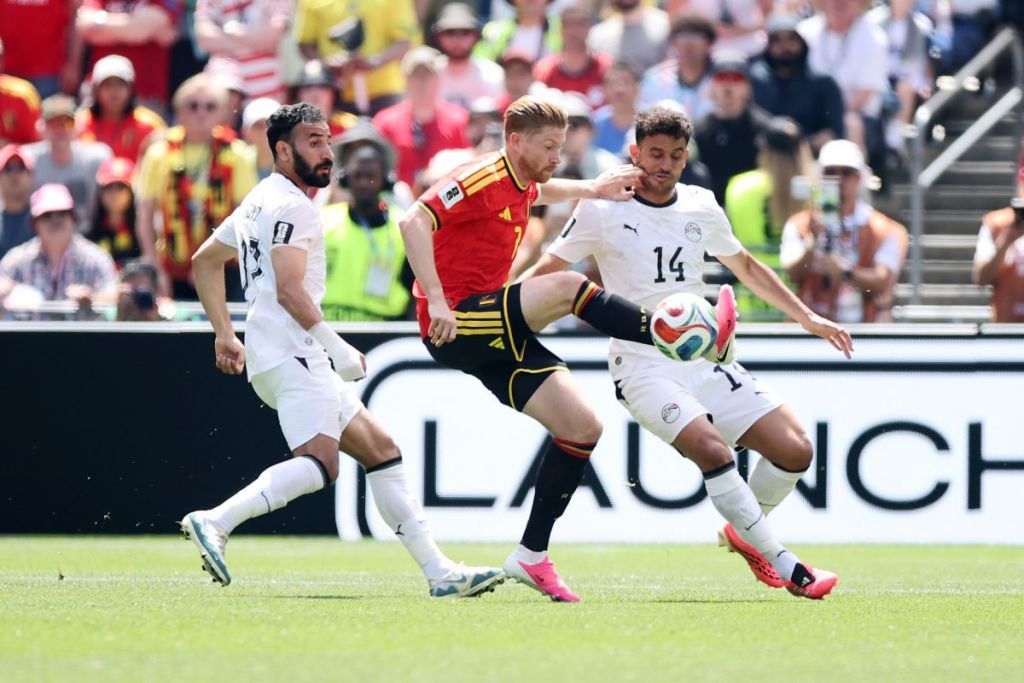
Belgium vs Iran FIFA World Cup 2026 Post-Match Analysis: Beiranvand Heroics and Ngoy’s Red Card Produce a Dramatic 0-0
The Belgium vs Iran FIFA World Cup 2026 Group G clash at SoFi Stadium in Los Angeles on June 21 was one of the most gripping, infuriating, and ultimately dramatic goalless draws this World Cup has produced. Belgium dominated the ball for 65 minutes with the weight of a nation’s expectations pressing down on every pass, only for a catastrophic moment of individual error from young defender Nathan Ngoy — a reckless foul on Mehdi Taremi that earned a straight red card — to flip the entire match on its head. Iran, playing with 11 men against 10 for the final 25 minutes, pushed and probed relentlessly for a winner that would have sent Group G into complete chaos.
In the end, neither team found the breakthrough. The scoreboard read 0-0, and the post-match reaction from both camps reflected the rollercoaster that 90-plus minutes in Los Angeles had delivered. For Belgium, it is two draws from two group games and mounting pressure. For Iran, it is a point that feels like so much more, earned through extraordinary collective defending and the individual brilliance of goalkeeper Alireza Beiranvand. Let’s break it all down.
Belgium vs Iran FIFA World Cup 2026 — Full Match Summary
Belgium Dominate From the Off — But Iran’s Wall Holds Firm
The Belgium vs Iran FIFA World Cup 2026 match began with the kind of Belgian possession dominance that has become the Red Devils’ calling card under Rudi Garcia. With Kevin De Bruyne dictating tempo from deep and Youri Tielemans pulling the strings in the half-spaces, Belgium monopolised the ball from the very first minute — reportedly controlling 80% of possession across the first 45 minutes. It was total, suffocating, one-way traffic.
But Iran, superbly organised by manager Amir Ghalenoei in a resolute low-block, were absolutely immovable. With Saeid Ezatolahi and Mohammad Mohebbi sitting deep in a disciplined midfield shield and every outfield player willing to put their body on the line, the Iranians blocked, cleared, and repelled everything the Red Devils could produce. Belgium attacked primarily down the left side, where Leandro Trossard repeatedly beat Saleh Hardani to cause panic across the Iranian defence — but the final ball and the finishing touch consistently eluded them.
The early flashpoint came in just the 4th minute, when Romelu Lukaku received a yellow card from Argentine referee Dario Herrera after a heavy challenge. It was a warning that would prove significant later in the context of Belgium’s physical approach, and it signalled the combative tone that would define the afternoon at SoFi Stadium.
Goalkeeper Alireza Beiranvand was the undisputed star of the first half, producing a string of world-class interventions. He twice denied De Bruyne — including an extraordinary left-arm deflection when it seemed easier to score — and single-handedly prevented Belgium from taking what their possession deserved. In the 21st minute, Tielemans unleashed a high-powered shot toward the near post that went agonisingly close. A De Cuyper volley from a diagonal Tielemans ball in the 44th minute was swallowed up by Beiranvand with characteristic calm.
Iran’s best moment of the first half came in the 11th minute, when Mehdi Taremi’s clever free-kick routine found a pocket of space, but the VAR system correctly flagged him offside before he could threaten Thibaut Courtois’s goal. The VAR intervention brought brief heartbreak for Iran but confirmed what replays showed — Taremi had the right idea, just the wrong positioning.
Half-Time: Belgium 0-0 Iran
The Red Card That Changed Everything — Ngoy’s Nightmare Moment
The second half of the Belgium vs Iran FIFA World Cup 2026 match opened with Belgium continuing to press for the breakthrough, and the first 20 minutes after the restart maintained the same pattern of the first half — Belgian possession, Iranian resistance, Beiranvand brilliance.
Then came the moment that changed everything.
In the 66th minute, in what ESPN described as a “single momentary lapse of concentration,” 23-year-old Belgian defender Nathan Ngoy lost control of the ball completely under pressure from Mehdi Taremi. The Iranian captain, instinctive and predatory as ever, seized on the error and was in on goal with a clear path. With no teammate covering and no other option available, Ngoy hauled Taremi down. Referee Herrera had no hesitation — straight red card. Belgium reduced to ten men. Iran presented with a penalty area that suddenly looked much more accessible.
The change in the match from that moment was, as ESPN’s live commentator noted, “almost like a different sport.” Belgium, now a man down, were forced to reshuffle defensively, with Rudi Garcia throwing on defender Arthur Theate in place of an attacking option. The tactical message was unmistakable — protect the point, hope for a counter.
Iran, energised by the red card and the crowd that had turned firmly behind the underdogs, poured forward. Milad Mohammadi, Alireza Jahanbakhsh, and eventually Shahriyar Moghanloo — introduced as Saman Ghoddos was replaced — all threatened to find the breakthrough. Taremi, now operating with more freedom, was a constant menace in the final third.
But Belgium, despite the numerical disadvantage, defended with remarkable organisation and character. Thibaut Courtois made the saves he needed to make when Iran’s pressure intensified. De Bruyne dropped deeper to shield the defence. And with each passing minute, it became increasingly clear that the 0-0 scoreline would survive the final whistle.
Final Score: Belgium 0-0 Iran
Tactical Breakdown — How Belgium vs Iran FIFA World Cup 2026 Unfolded
Belgium’s Possession Game — All Control, No Cutting Edge
Rudi Garcia deployed Belgium in their customary 4-3-3 formation for the Belgium vs Iran FIFA World Cup 2026 encounter, with Thibaut Courtois in goal, a back four of Meunier, Mechele, Ngoy, and De Cuyper, and a midfield trio of Raskin, Tielemans, and De Bruyne supporting a front three of Saelemaekers, Lukaku, and Trossard.
The plan was straightforward — control the ball, use De Bruyne’s vision and range of passing to create, and allow Trossard’s pace on the left to stretch Iran’s defensive structure. Belgium achieved the control part magnificently. Their pass accuracy, movement, and possession statistics were remarkable — including that eye-catching 80% possession figure in the first half.
The problem was the final third. Only 20% of Belgium’s shots were on target across the entire match — an astonishing statistic given the dominance they exercised. Iran’s low-block absorbed every attempt and Beiranvand mopped up anything that got through. Belgian coach Rudi Garcia was explicit in his post-match assessment: “Our lack of clinical finishing, with only 20% of shots on target, ultimately prevented us from securing the win.”
Iran’s Low-Block Masterclass — Ghalenoei’s Tactical Triumph
Amir Ghalenoei’s 4-5-1 defensive structure in the Belgium vs Iran FIFA World Cup 2026 match was one of the most disciplined, organised, and physically demanding defensive performances of the entire 2026 tournament. With Taremi isolated at the tip of a defensive pyramid and every other outfield player tasked with blocking, running, and covering, Iran executed their gameplan with extraordinary precision for 90 minutes.
The key was discipline. Iran’s midfield five — Mohebbi, Ezatolahi, Ghoddos, Rezaeian, and eventually their substitutes — worked tirelessly in narrow channels, collapsing onto every Belgian attacker who received the ball inside the box and preventing the kind of through-ball opportunities that De Bruyne usually exploits with ease.
When Iran had the ball — admittedly rarely in the first half — they were smart and direct, using Taremi’s physical strength to hold up play and wait for support. The red card moment, as devastating as Ngoy’s individual error was, ironically played into Iran’s hands perfectly at the 66-minute mark, giving them the numerical advantage they needed for the final push.
Player Ratings — Belgium vs Iran FIFA World Cup 2026
Belgium
- Thibaut Courtois — 7.5: Made the saves he needed to make under significant second-half pressure from a man-up Iran. His composure during the final 25 minutes was crucial to preserving the point.
- Thomas Meunier — 6.5: Solid enough on the right without ever being a dominant attacking influence. Replaced late as Garcia reshuffled.
- Brandon Mechele — 7.0: Calm and composed in the heart of the Belgian defence. Managed the Iranian pressure well in the difficult closing stages.
- Nathan Ngoy — 3.0: The red card that changed the entire match. His loss of ball under pressure from Taremi and the subsequent foul was a catastrophic moment for a 23-year-old who will learn a very hard lesson from the experience in Los Angeles.
- Maxim De Cuyper — 7.5: Belgium’s most dangerous attacker in the first half. His overlapping runs on the left created the best openings Belgium produced, and his volley in the 44th minute was saved magnificently by Beiranvand.
- Nicolas Raskin — 6.5: Quietly efficient in the midfield base. Worked hard to cover Ngoy’s absence after the red card.
- Youri Tielemans — 7.5: Belgium’s creative heartbeat alongside De Bruyne. His passing range was excellent, particularly the diagonal ball to De Cuyper in the first half.
- Kevin De Bruyne — 7.0: Still dangerous but increasingly frustrated as the match progressed. Denied twice by Beiranvand at close range. Dropped deeper to shield the defence after the red card. At 35, these World Cups are not getting easier.
- Alexis Saelemaekers — 6.0: Worked hard on the right but lacked the final touch in dangerous positions. Replaced in the second half.
- Romelu Lukaku — 6.0: Yellow card in the fourth minute curtailed his physical game. Still a presence in the box but was denied by Beiranvand and the Iranian defensive wall. An frustrating evening for Belgium’s captain and talisman.
- Leandro Trossard — 7.5: Belgium’s most threatening player in open play. Repeatedly beat Hardani down the left and forced Iran into panic defending in the first half. Deserved more from the game in terms of goal contributions.
Iran
- Alireza Beiranvand — 9.5 ⭐ (Player of the Match): Absolutely sensational. Multiple world-class saves — including the extraordinary left-arm deflection to deny De Cuyper a certain tap-in — kept Iran in the match when Belgium’s quality should have been decisive. A goalkeeper performance for the ages.
- Hossein Kanani — 7.5: Excellent in the heart of Iran’s defence. Won aerial duels, blocked shots, and organised those around him throughout a gruelling 90 minutes.
- Shoja Khalilzadeh — 7.5: Commanding alongside Kanani. His reading of the game and his positioning were outstanding, especially during Belgium’s first-half bombardment.
- Saeid Ezatolahi — 7.0: The midfield anchor who kept Iran’s defensive shape intact. Booked in the first half but managed his yellow card well and remained a key organising figure throughout.
- Ehsan Hajisafi — 7.0: The experienced left-back was a calming presence and showed real quality in managing Belgium’s right-sided threat.
- Mehdi Taremi — 7.5: The VAR-disallowed goal was unfortunate. The penalty area foul that won the red card was the match’s decisive moment. Throughout, Taremi worked tirelessly to hold up play with minimal support.
- Alireza Jahanbakhsh — 7.0: Introduced as a substitute and immediately added energy and direct running that Iran had been missing before his introduction.
Key Statistics — Belgium vs Iran FIFA World Cup 2026
| Stat | Belgium | Iran |
|---|---|---|
| Final Score | 0 | 0 |
| Possession (1st Half) | 80% | 20% |
| Shots on Target | 20% conversion | — |
| Red Cards | 1 (Ngoy, 66′) | 0 |
| Yellow Cards | 2 (Lukaku, ?) | 1 (Ezatolahi) |
| Key Saves | — | 6+ (Beiranvand) |
| VAR Interventions | 1 | 1 |
The defining statistic from the Belgium vs Iran FIFA World Cup 2026 match is the extraordinary gulf between Belgium’s possession dominance and their conversion rate. An 80% first-half possession figure that yielded zero goals tells the entire story of Belgium’s evening — complete control of the ball, zero clinical edge when it mattered.
Ngoy’s Red Card — The Moment That Defined Belgium vs Iran FIFA World Cup 2026
If one single moment defined the Belgium vs Iran FIFA World Cup 2026 encounter, it was Nathan Ngoy’s catastrophic 66th-minute red card. The 23-year-old Belgian defender — who had been quietly competent for much of the first hour of the match — lost the ball under pressure from Taremi in a moment that ESPN described as a “single momentary lapse of concentration” that blew the game wide open.
The challenge on Taremi, who was through on goal, left referee Dario Herrera with no option but to show a straight red card for denial of a goalscoring opportunity. It was the correct decision, and the punishment was clear and immediate in its impact — Belgium suddenly vulnerable, Iran suddenly energised.
Young defenders make mistakes at this level. Ngoy, at 23, will carry this moment with him and — if his mentality is right — grow from it enormously. But in the context of Belgium’s World Cup campaign, it was a hammer blow to a team that was already running low on time to accumulate points from Group G.
Beiranvand’s World-Class Saves — A Goalkeeper on the Form of His Life
No post-match analysis of the Belgium vs Iran FIFA World Cup 2026 match would be complete without a dedicated appreciation of Alireza Beiranvand’s extraordinary performance. The Iranian goalkeeper — who plays his club football in Europe and is one of Asia’s most experienced stoppers — was simply unbeatable throughout 90 minutes at SoFi Stadium.
His most remarkable moment came when De Bruyne’s perfectly weighted cross found what appeared to be a certain De Cuyper tap-in at the far post. In a flash of pure reflexive genius, Beiranvand threw out his left arm to deflect the ball to safety. It was the kind of save that wins games — and on this evidence, it won Iran a point they thoroughly deserved.
For historical context on Iran’s World Cup goalkeeping records and Beiranvand’s incredible career story — he grew up in poverty and played barefoot before reaching the sport’s highest level — visit the official FIFA World Cup player profiles page for comprehensive background.
What This Result Means for Group G
The Belgium vs Iran FIFA World Cup 2026 draw means that, remarkably, all four teams in Group G — Belgium, Iran, Egypt, and New Zealand — entered the third round of fixtures level on points. It is one of the tightest, most unpredictable group stage scenarios the World Cup has ever produced, with every team still in contention and nothing decided heading into the final fixtures.
Belgium’s failure to win means they must secure a result in their final group game to guarantee a place in the Round of 32. Iran, meanwhile, have shown they can compete with European opposition — and their final group game gives them a genuine opportunity to advance.
For the complete and fully updated Group G standings table, visit the official FIFA World Cup 2026 Group G page on FIFA.com for live qualification scenarios and points tables.
For expert tactical breakdowns of all Group G permutations heading into the final round, Bleacher Report’s World Cup 2026 live blog has comprehensive analysis from the SoFi Stadium press box.
What’s Next for Belgium?
Belgium now face a must-win final group game. With Nathan Ngoy suspended following his red card, Rudi Garcia will need to reconfigure his defensive options — likely bringing in Arthur Theate to partner Mechele in central defence. The bigger concern remains the attacking end, where Belgium’s inability to convert possession into goals has now cost them six points from a possible six across two group games.
Kevin De Bruyne, at 35, is running out of World Cups. The urgency around Belgium’s next performance is enormous. For the latest Belgium squad news, Ngoy’s suspension details, and pre-match build-up, visit the official Belgian Football Association website at rbfa.be for all official updates.
What’s Next for Iran?
Iran head into their final group game with enormous confidence and a point that feels like a moral victory against one of Europe’s most talented squads. Beiranvand’s form, the defensive organisation Ghalenoei has installed, and Taremi’s leadership give Iran a genuine platform to build on.
A win in the final group fixture, combined with the right result elsewhere, could see Iran advance from Group G for the first time in their World Cup history. For Iran fans, the official Football Federation of the Islamic Republic of Iran (FFIRI) website carries all team news and match updates throughout the tournament.
Final Thoughts on Belgium vs Iran FIFA World Cup 2026
The Belgium vs Iran FIFA World Cup 2026 post-match analysis tells the story of two very different kinds of performance — and somehow, neither was rewarded with a victory. Belgium were brilliant in possession and completely toothless in front of goal. Iran were resolute, organised, and breathtakingly brave — then found themselves gifted a man advantage they could not convert.
Alireza Beiranvand is the undisputed hero with a 9.5-rated performance that belongs in the conversation about the finest individual goalkeeping displays of any World Cup in living memory. Nathan Ngoy carries the weight of a decision that cost Belgium dearly. Kevin De Bruyne and Leandro Trossard did everything right except score.
Group G is now wide open. And in Los Angeles, on June 21, 2026, Iranian football showed the world that they are not at this World Cup simply to make up the numbers. They are here to compete — and on this evidence, they absolutely can.
One Comment