


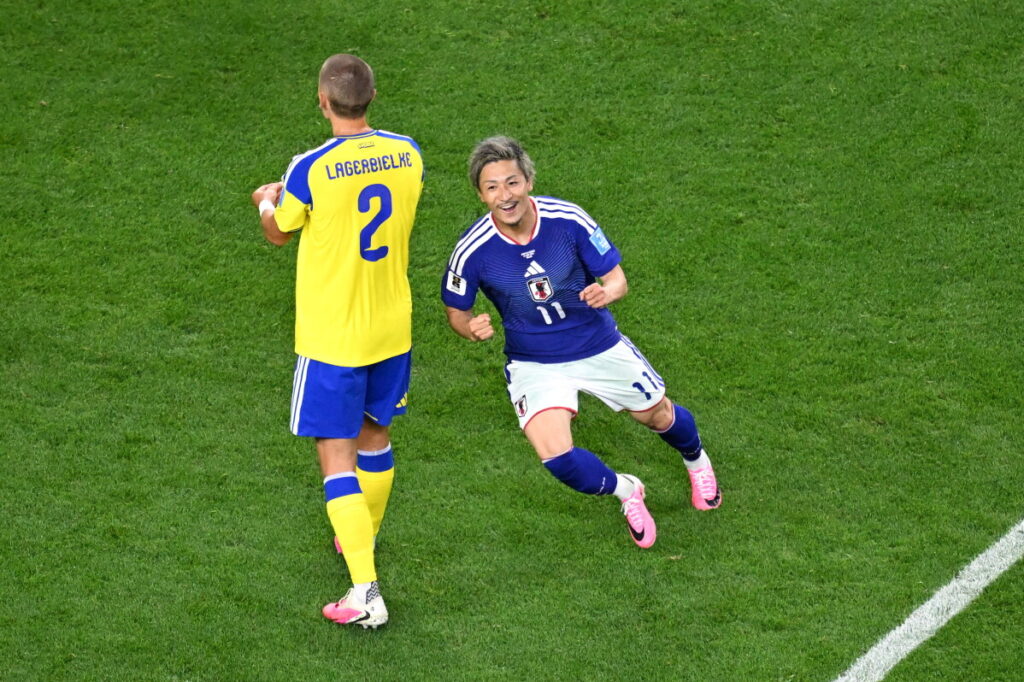
Japan vs Sweden World Cup 2026 produced one of the most dramatic and satisfying Group F conclusions this tournament could have scripted. At AT&T Stadium in Arlington, Texas — the largest stadium in the 2026 World Cup by capacity, and one of the most spectacular sporting venues in the world — Hajime Moriyasu’s Samurai Blue and Graham Potter’s Blågult delivered a match that had everything: a dull but tense first half, a gorgeous team goal, a thunderous equaliser, a goalkeeper’s redemption arc in the final minutes, and a result that sent both nations into the Round of 32. Daizen Maeda, finishing brilliantly after a brilliant Ritsu Doan through-ball in the 56th minute, gave Japan the lead. Anthony Elanga’s left-footed cross-shot six minutes later levelled the contest. And then, in the most dramatic passage of play in the match’s final quarter-hour, Sweden’s Alexander Isak came agonisingly close to sending his nation through as Group F runners-up — only for Japan’s Zion Suzuki to produce a world-class late save that preserved the draw and confirmed the standings as they ended.
The Japan vs Sweden World Cup 2026 Group F Matchday 3 showdown was packed with narrative tension from the very start — because both teams knew, before a ball was kicked, that the simultaneous fixture between the Netherlands and Tunisia at Arrowhead Stadium in Kansas City would directly affect their own fate. The Netherlands, with six points, were already qualified. If they won in Kansas City, Japan would advance as runners-up regardless of this result. If the Netherlands drew, Sweden needed at least a draw themselves to advance. As news filtered through from Kansas City during the first half — the Netherlands building a 2-0 lead — the tactical calculation shifted subtly but significantly. By the 56th minute, when Maeda scored, it had crystallised entirely into the most complex Group F equation Dallas had ever been asked to solve.
Japan vs Sweden World Cup 2026: Full Match Report
Hajime Moriyasu named his strongest available side for the Japan vs Sweden World Cup 2026 Group F finale, selecting goalkeeper Zion Suzuki behind a back four of Yukinari Sugawara, Ko Itakura, Hiroki Ito, and Ayumu Seko. Ritsu Doan and Keito Nakamura provided the width in a fluid 4-2-3-1 shape, with Daichi Kamada and Ao Tanaka anchoring the midfield. Daizen Maeda — who had been one of Japan’s most industrious forwards across Matchdays 1 and 2 — led the attack alongside Ayase Ueda. Graham Potter’s Sweden, meanwhile, were without the suspended Emil Forsberg but named Alexander Isak and Anthony Elanga in a two-striker partnership, with Viktor Gyökeres dropping to the bench. Dejan Kulusevski operated in his familiar attacking midfield role, linking the defensive work of Mattias Svanberg and Martin Zubimendi with the forward line.
The atmosphere inside AT&T Stadium was extraordinary even before kick-off. Japan’s passionate support — many thousands of Samurai Blue fans who had crossed the Pacific to be present — filled sections of the stadium with red and white, generating a wall of sound that matched anything produced elsewhere at this tournament. Sweden’s Blågult contingent — smaller but intensely vocal — answered with chants of their own. For a match between a group already-qualified nation and a team needing at least a draw, the noise inside one of America’s most iconic sporting arenas was something to behold.
First Half: Tactical Chess, Goalless But Gripping
The first 45 minutes of the Japan vs Sweden World Cup 2026 match were, by common agreement, poor in terms of goalscoring chances but fascinating in their tactical complexity. Japan — who needed only a draw to confirm their progress — set up in a compact, organised defensive shape that denied Sweden the space their forwards needed. Moriyasu instructed his fullbacks to stay disciplined and resist the temptation to push forward, keeping Sweden’s Elanga and Isak — two of the most dangerous counter-attacking forwards in European football — from exploiting the space behind the defensive line.
Sweden pressed with intent in the first quarter, Kulusevski driving forward from midfield and Isak making intelligent runs in behind Japan’s defensive line. But Japan’s centre-back partnership of Ko Itakura and Hiroki Ito was magnificent in reading and nullifying those runs. In the 20th minute, Isak managed to work a half-chance from the edge of the area, his left-footed effort requiring a straightforward gather from Suzuki. Sweden’s best first-half opportunity came in the 31st minute when a Kulusevski diagonal found Elanga in space on the right — but the Manchester United winger’s first touch was heavy and Seko was able to position himself perfectly to clear before the shot could be attempted.
Japan, for their part, were content to absorb and counter. Ritsu Doan created two dangerous moments with his intelligent positioning behind Sweden’s defensive midfield, and Maeda’s relentless pressing — five high-intensity pressing actions in the first half alone — gave Sweden’s centre-backs very little time on the ball. But neither team managed a meaningful shot on target in the entire first half. The nil-nil at half-time was entirely representative of a match that had been defined by caution and intelligence rather than abandon and attack. Both coaches, knowing their respective tournament situations, were content to wait for the right moment.
Second Half: Maeda’s Gorgeousness, Elanga’s Thunderbolt, Suzuki’s Heroics
The Japan vs Sweden World Cup 2026 match changed character entirely at the start of the second half — not because either team made tactical changes, but because the news arriving from Kansas City had shifted the pressure. The Netherlands were 3-0 up against Tunisia. Both Japan and Sweden knew that a draw would send them both through. Perversely, this opened the game: with the immediate fear of losing their tournament life slightly reduced, both teams attacked with greater freedom.
Japan broke the deadlock on the hour mark, and the goal was — as ESPN described in their live match commentary — a gorgeous team goal. Ao Tanaka intercepted a Sweden clearance in the centre circle and immediately fed Ritsu Doan in space on the left side. Doan — the Bayer Leverkusen winger who had been Japan’s most creative threat all evening — assessed his options in an instant, then played a beautifully disguised, perfectly weighted through-ball into the path of Daizen Maeda. The Benfica striker arrived at exactly the right moment, beat his defender’s attempt at an offside trap, and slotted the ball calmly past Viktor Johansson inside the right post. Japan 1-0. AT&T Stadium erupted in red and white. The Samurai Blue were ahead with just over 30 minutes to play.
Sweden’s response was immediate and emphatic. Graham Potter’s substitution — bringing on Viktor Gyökeres for Martin Zubimendi at the same time the goal was scored — added an explosive physical presence to Sweden’s attack, and within six minutes of going behind, the Blågult were level. A quick Swedish break down the right found Kulusevski with space. He looked up, and instead of crossing, played a low, clever pass inside to Anthony Elanga arriving at pace. Elanga, with his left foot, did not attempt a conventional cross — he hit it with a deliberately reduced swing, a cross-shot aimed at the near post. It flew past Zion Suzuki before the goalkeeper could adjust his position. The Japanese goalkeeper clearly did not expect the pace of the strike. 1-1. Sixty-two minutes gone. AT&T Stadium — now completely polarised between two equally loud sets of fans — shook with noise.
The final twenty-five minutes of the Japan vs Sweden World Cup 2026 clash produced extraordinary tension. Sweden pushed for a winner — the Group F runners-up spot would earn them a slightly more favourable Round of 32 draw, but more importantly the national pride of finishing above Japan — and Alexander Isak was the man who came closest to delivering it. His 78th-minute header from a Kulusevski corner was well saved by Suzuki, who had improved dramatically after his lapse for Elanga’s goal. In the 85th minute, Isak collected a through-ball from Gyökeres, drove into the penalty area, and unleashed a powerful left-footed drive toward the far corner. Suzuki threw himself to his right and, with a strong glove, pushed the ball behind for a corner. It was the save of the match — the moment that preserved Japan’s point and their position as Group F runners-up. When the final whistle blew, both sets of fans applauded both teams off the pitch. Both had earned it.
Key Moments: Japan vs Sweden World Cup 2026
Daizen Maeda and Ritsu Doan: Japan’s Brilliant Partnership
The goal that opened the scoring in the Japan vs Sweden World Cup 2026 match was a masterclass in the understanding that has developed between two of Japan’s most important attacking players. Ritsu Doan — the Bayer Leverkusen winger who had scored two goals and registered three assists across the group stage — demonstrated in one single pass exactly what makes him the most complete Japanese player of his generation. He received Tanaka’s interception pass, assessed Sweden’s defensive shape in a fraction of a second, and then delivered a through-ball of the highest quality that only Maeda — already making his diagonal run — could have reached.
🇯🇵 Japan’s Group F Campaign — Samurai Blue’s Historic Consistency
- Matchday 1 vs Tunisia: Won 2-0 — Ueda brace; controlled from start to finish
- Matchday 2 vs Netherlands: Drew 1-1 — Kamada equaliser; resilient defensive display
- Matchday 3 vs Sweden: Drew 1-1 — Maeda goal; Suzuki late heroics
- Group F finish: 5 points — runners-up to Netherlands (7 points)
- Round of 32 opponent: Brazil (Group C winners)
- Japan’s key statistic: Conceded just 2 goals in 3 group games — one of the tournament’s most resilient defences
- Ritsu Doan: 2 goals + 3 assists across the group stage — Japan’s outstanding individual performer
Maeda’s finish was every bit as impressive as the assist. Running at full pace, on the very edge of offside, he needed one touch to control and one touch to shoot — and both were executed with the clinical calmness of a player entirely at home on the world stage. His 16 high-intensity pressing actions across the match were the most of any player on the pitch according to live Opta data, reflecting a work-rate that makes him invaluable to Moriyasu’s system even on evenings when his goal contribution is limited. Tonight, both the work-rate and the goal arrived together. For a full breakdown of Japan’s squad and how Moriyasu has set up for this tournament, read our Japan FIFA World Cup 2026 tactical preview.
Anthony Elanga’s Defining Moment: A Goal as Intelligent as It Is Beautiful
Anthony Elanga’s equaliser in the Japan vs Sweden World Cup 2026 match will be replayed for years — not just because it was decisive, and not just because it was beautifully struck, but because of the intelligence that produced it. When Kulusevski played him into space inside Japan’s penalty area, Elanga had multiple options. He could have attempted a conventional cross. He could have tried to cut back and shoot with his stronger right foot. He chose instead to hit a deliberately paced left-footed shot toward the near post — creating a cross-shot hybrid that wrong-footed Zion Suzuki entirely. The goalkeeper, expecting either a cross or a shot toward the far post, was caught completely flat-footed. The ball flew past him before he could adjust.
It was, in the truest sense, a goal born of football intelligence. Elanga — the Manchester United winger who had been developing his game across the 2025-26 Premier League season with growing maturity — showed exactly why Graham Potter had faith in him as a starter for this crucial Group F finale. His pressing statistics across the match matched Maeda’s for work-rate, and his dribbling attempts — three completed out of four, according to SofaScore’s match data — reflected a player willing to take responsibility in one-on-one situations. Sweden go into the Round of 32 against France knowing Elanga is in the form of his life. Explore our Sweden FIFA World Cup 2026 tactical preview for a full breakdown of Potter’s system heading into the knockouts.
Zion Suzuki: From Lapse to Redemption in 23 Minutes
One of the most compelling individual storylines of the Japan vs Sweden World Cup 2026 match was Zion Suzuki’s personal journey across 90 minutes. For the goalkeeper’s lapse — allowing Elanga’s cross-shot to fly past him at the near post in the 62nd minute, a save he will feel he should have made — threatened to cost Japan dearly for the entire final third of the match. But Suzuki, the 22-year-old Parma goalkeeper who is rapidly establishing himself as one of Japan’s most important players, responded in exactly the right way.
His 78th-minute save from Isak’s back-post header was confident and composed. His 85th-minute stop from Isak’s powerful left-footed drive — a save that, in the context of the match, was decisive — was extraordinary. Diving low to his right, extending his arm fully, he got enough of a glove on the ball to divert it around the post with just five minutes to play. Had that gone in, Sweden would have been Group F runners-up, and Japan would have faced an even tougher Round of 32 opponent in France. Instead, Suzuki’s brilliance preserved the draw, preserved Japan’s second-place position, and preserved their date with Brazil — a formidable opponent, but one they would face as a side buoyed rather than deflated by this evening’s events.
Tactical Analysis: How Moriyasu and Potter Set Up Their Teams
Japan’s Pragmatic 4-2-3-1 — Disciplined and Dangerous
Hajime Moriyasu’s tactical approach in the Japan vs Sweden World Cup 2026 match was a masterclass in intelligent tournament football. He did not ask his team to dominate possession — instead, he designed a system that could absorb pressure for sustained periods, then strike with devastating precision when the opportunity arose. The Doan-to-Maeda through-ball that produced Japan’s goal was not a lucky break. It was the product of a system that had practised exactly that type of quick vertical transition from midfield to forward across countless training sessions.
Japan’s defensive record across the group stage — just two goals conceded in three matches — reflects the outstanding individual performances of Itakura and Ito at centre-back, Tanaka’s screening in front of them, and Suzuki’s (largely) dependable goalkeeping. With Brazil awaiting in the Round of 32, that defensive resilience will need to be maintained against the most attacking squad remaining in the tournament. Japan’s ability to produce clinical counter-attacking goals from a base of defensive solidity is their greatest strength going into the knockout phase.
Sweden’s Attacking Ambition — Too Cautious Early, Too Late Late
Graham Potter’s Sweden were the more attacking side across the full 90 minutes in the Japan vs Sweden World Cup 2026 match, generating the game’s most dangerous moments through Isak, Elanga, and the excellent Kulusevski. But the decision to leave Gyökeres on the bench for the first hour — in a match where Sweden needed to win to secure top spot in the group — will generate debate. When Gyökeres entered in the 62nd minute, alongside the equaliser that changed Sweden’s mindset, his physical presence immediately created additional problems for Japan’s centre-backs. Had he started from the first whistle, Sweden might have found the breakthrough in the first half when Japan were most conservative.
The Key Tactical Battle That Defined Japan vs Sweden World Cup 2026
The most important tactical duel in this match was the contest between Kulusevski and Japan’s left side. The Tottenham midfielder — operating in his free-roaming attacking midfield role — drifted intelligently between Japan’s lines and caused Ayumu Seko genuine problems in the first half with his diagonal runs. Had Sweden exploited this matchup more consistently in the opening 45 minutes, the outcome of the Japan vs Sweden World Cup 2026 encounter might have been very different. Instead, Japan managed the first half sufficiently well before striking first with Maeda’s brilliant goal. Read our Japan World Cup 2026 group stage review for a full statistical and tactical breakdown of the Samurai Blue’s campaign.
🇯🇵 Japan — Smart Tournament Football
- Compact 4-2-3-1 that absorbed Sweden’s early pressure
- Doan-Maeda combination for the goal — tournament quality
- Itakura and Ito outstanding at centre-back all evening
- Suzuki’s late save from Isak was match-defining heroism
- Maeda’s 16 pressing actions — the highest on the pitch
- 5 points from 3 games — one of Asia’s finest group campaigns
🇸🇪 Sweden — Quality Without the Killer Blow
- Elanga’s cross-shot was technically and intellectually brilliant
- Isak denied twice by Suzuki in the final quarter-hour
- Kulusevski creative throughout — Tottenham quality on display
- Gyökeres’ late introduction may have come too late
- Svanberg and Zubimendi composed midfield presence
- France in the Round of 32 — a formidable test awaits
Player Ratings: Japan vs Sweden World Cup 2026
Japan Player Ratings
| Player | Pos | Rating | Key Note |
|---|---|---|---|
| Zion Suzuki | GK | 7.5 | Lapse for Elanga’s goal; redeemed himself brilliantly with two crucial saves from Isak |
| Yukinari Sugawara | RB | 7.0 | Disciplined and progressive; helped Japan’s right side remain compact against Elanga |
| Ko Itakura | CB | 8.0 | Excellent — read Isak’s runs brilliantly throughout; dominant in the air |
| Hiroki Ito | CB | 7.8 | Composed and commanding — kept Gyökeres quiet throughout his second-half cameo |
| Ayumu Seko | LB | 6.8 | Tested by Kulusevski’s diagonal runs in the first half; managed it well overall |
| Ao Tanaka | CM | 7.2 | The interception that led to Maeda’s goal was his defining moment; solid throughout |
| Daichi Kamada | CM | 6.8 | Covered ground diligently; kept Sweden’s midfield from connecting with the forward line |
| Keito Nakamura | RW | 6.5 | Quiet by his usual standards; replaced by Junya Ito as Moriyasu managed minutes late on |
| Ritsu Doan ⭐ | LW | 8.5 | The assist for Maeda’s goal was the match’s finest individual moment; relentless and creative |
| Ayase Ueda | CF | 6.2 | Often isolated; replaced by Shuto Machino at 72′; worked tirelessly without much service |
| Daizen Maeda ⭐ MOTM | FW | 8.5 | Tournament-quality finish; 16 pressing actions; Japan’s most complete individual display of the evening |
| Junya Ito (sub) | RW | 6.5 | Added pace and directness as Japan managed the final minutes; helped relieve pressure |
Sweden Player Ratings
| Player | Pos | Rating | Key Note |
|---|---|---|---|
| Viktor Johansson (GK) | GK | 6.2 | Could not prevent Maeda’s well-placed finish; comfortable otherwise; beaten at near post |
| Mikael Lustig | RB | 6.5 | Experienced presence at right-back; provided width but rarely crossed effectively |
| Isak Jansson | CB | 6.0 | Could not prevent Maeda’s diagonal run for the opening goal; struggled to hold his line |
| Marcus Danielsson | CB | 6.5 | Better in the second half; aerial dominance improved once Gyökeres added a physical presence |
| Oscar Wendt | LB | 6.8 | Contributed to attacking play on the left; defensive positioning solid throughout |
| Mattias Svanberg | CM | 7.0 | Competitive and diligent in midfield; won important second balls and kept Sweden organised |
| Martin Zubimendi | CM | 6.8 | The Spanish-born midfielder managed the tempo well; replaced by Guilavogui at 62′ |
| Dejan Kulusevski ⭐ | AM | 8.0 | Creative throughout — the assist for Elanga’s equaliser was perfectly measured and judged |
| Anthony Elanga ⭐ | RW | 8.5 | The cross-shot equaliser was a product of intelligence and technique; three completed dribbles |
| Alexander Isak | CF | 7.0 | Twice denied by Suzuki late on; physical and dangerous but lacked final-touch quality when needed |
| Jesper Karlsson | LW | 6.0 | Limited impact on Japan’s right-back; replaced at half-time with Sweden pushing for more |
| Viktor Gyökeres (sub) | CF | 7.2 | Immediate impact — created multiple second-half situations; the assist for Isak’s 85th-minute chance |
Group F Final Standings and the Road to the Knockouts
📊 Group F Final Standings — After Matchday 3
- 🥇 Netherlands — 7 pts · GD +6 · Group winners → Round of 32 vs Morocco
- 🥈 Japan — 5 pts · GD +2 · Runners-up → Round of 32 vs Brazil
- 3rd Sweden — 4 pts · GD +1 · Third place → Round of 32 vs France
- 4th Tunisia — 0 pts · Eliminated
The Japan vs Sweden World Cup 2026 1-1 draw confirmed the Group F final standings in a way that was entirely fair to both nations. Japan go into the Round of 32 with five points from their three games — an excellent return that reflects the quality and organisation Hajime Moriyasu has built into this squad across a decade of development. They face Brazil in Texas, a match that will test every ounce of Japan’s defensive resilience and attacking ingenuity. It is, by any measure, the toughest possible Round of 32 opponent. But Japan’s group stage campaign — built on a 2-0 win over Tunisia, a brave draw with the Netherlands, and this hard-earned point against Sweden — suggests a team fully capable of producing surprises. For the full Round of 32 schedule and draw, visit the official FIFA World Cup 2026 match centre and our own Round of 32 complete draw and fixtures preview.
Sweden, meanwhile, advance as one of the eight best third-placed teams with four points — a result confirmed only when all twelve group stages were completed simultaneously. Their Round of 32 opponents are France — an equally daunting test, given the Bleus’ commanding group stage form. Alexander Isak and Anthony Elanga will need to find the finishing quality that eluded them in the final minutes at AT&T Stadium if Sweden are to compete with France’s defensively organised and technically brilliant squad. Further analysis can be found at VAVEL’s comprehensive live match coverage, SofaScore’s detailed match statistics, and our own Sweden World Cup 2026 group stage review.
Final Verdict: Japan vs Sweden World Cup 2026 — A Match of Character, Quality, and Consequence
The Japan vs Sweden World Cup 2026 Group F finale was not perfect football. The first half was played at a deliberately cautious tempo that frustrated rather than entertained. But the second half — from Maeda’s gorgeous 56th-minute goal to Suzuki’s magnificent 85th-minute save — delivered everything a neutral could ask for: drama, excellence, heartbreak, and redemption all within the space of thirty minutes at the largest stadium in World Cup 2026.
Japan deserved their point. Their defensive organisation was exceptional, their goal was beautifully constructed, and Suzuki’s late saves were the kind of performances that define goalkeepers at major tournaments. Sweden deserved their point too — Elanga’s goal was an inspired moment, Kulusevski was outstanding throughout, and Isak’s performance — two chances denied by a world-class save — reflected a striker unlucky not to find the net on another evening. Both teams gave AT&T Stadium a night to remember.
They each now face the hardest possible tests in the Round of 32: Japan against Brazil, Sweden against France. The magnitude of those challenges is enormous. But both nations walk into those matches knowing they have earned their place through genuine tournament quality, genuine resilience, and — as this extraordinary evening in Dallas confirmed — genuine heart.